Python - Report Lambdas
- Report Lambda Cheatset
- Define Report Program
- Run Report Program
- Read Report Results
- Initialize Report Lambda
- Read inputs of Report Lambda
- Volumetric Booleans in Report
- Load and Write Pandas
Report Lambda Cheatset
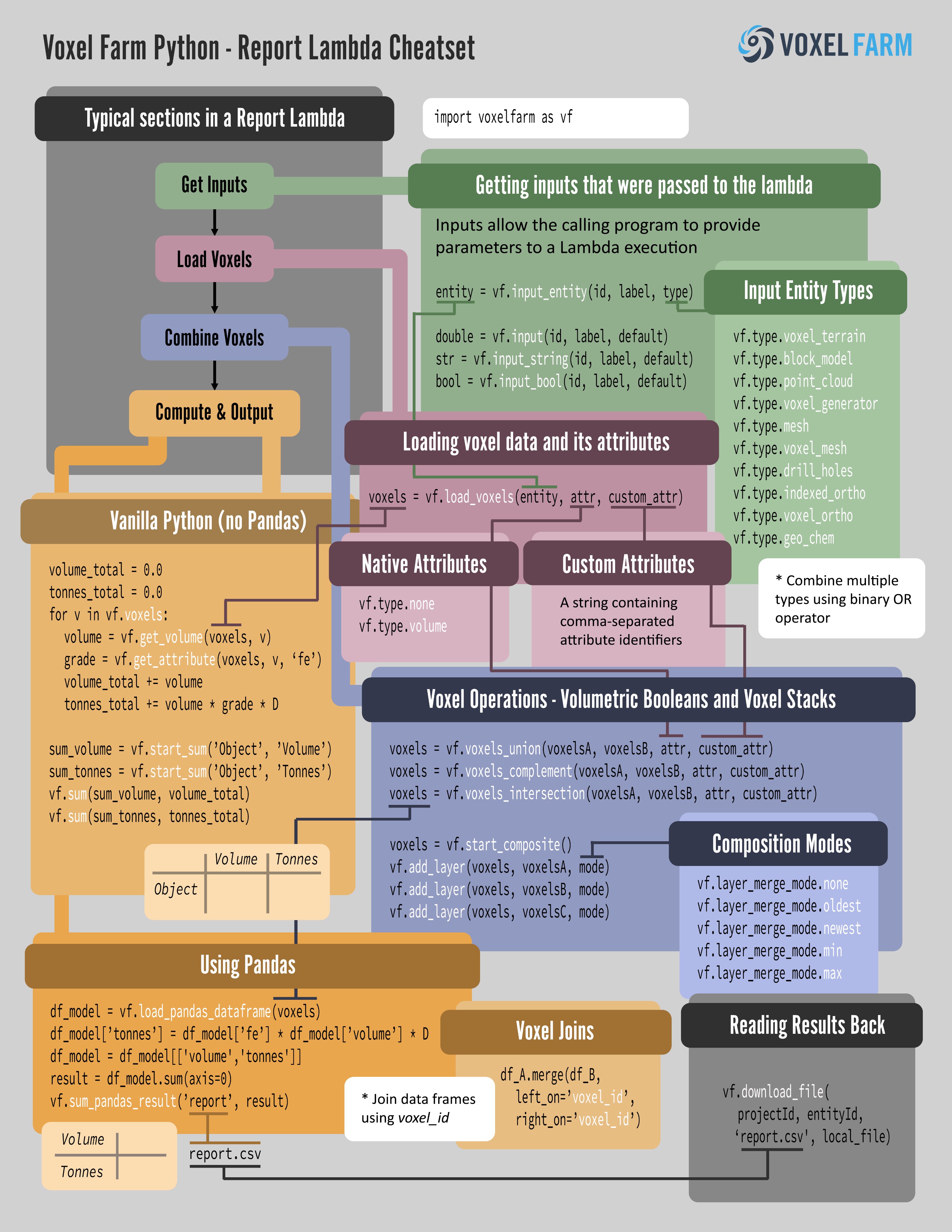
Define Report Program
This example creates a new report program.
result = vf.create_lambda_python(
    project=project,
    type=vf.lambda_type.Report,
    name="My Volume Report Lambda",
    fields={},
    code=open('./lambdas/ComputeVolumeLambda.py').read())
if not result.success:
    print(result.error_info)
    exit()
report_lambda_id = result.id
Run Report Program
The following example runs an existing Report Program with a given set of inputs.
# We will use a region that defines an 160 meter cube centered in the origin
region = '1,-80,80,-80,-80,80,-80,80,80,-80,80'
result = vf.create_report(
    project=project,
    program=report_lambda_id,
    region=region,
    lod=0,
    name='Volume of Cube',
    fields={},
    inputs={
        'entity' : voxmesh_id
    })
if not result.success:
    print(result.error_info)
    exit()
report_id = result.id
For more information on regions and how to trigger report programs, please check out the Triggering Reports topic.
Read Report Results
This example shows how to read the results of a Report Lambda execution.
# The "project" variable contains the Project ID
# The "report_id" variable contains the ID for the report entity
csvdata = vf.get_file(project, report_id, 'report.csv')
Initialize Report Lambda
This example shows how to initialize the Voxel Farm library in a report Lambda program.
import voxelfarm as vf
Read inputs of Report Lambda
The following example shows how to read inputs from a report lambda program.
mesh_entity = vf.input_entity("mesh_entity_id", "Entity", vf.type.voxel_mesh)
string_input = vf.input_string("string_input", "String Input", "")
numerical_input = vf.input("numerical_input", "Numerical Input", 0.0)
Volumetric Booleans in Report
This example shows how to create volumetric boolean operations between volumetric datasets.
# Get inputs, in this case the entities that will have they volumes computed
entityA = vf.input_entity("entityA", "Select Entity A", vf.type.voxel_generator | vf.type.voxel_terrain | vf.type.voxel_mesh)
entityB = vf.input_entity("entityB", "Select Entity B", vf.type.voxel_generator | vf.type.voxel_terrain | vf.type.voxel_mesh)

# Next, we will request to load voxel data for the entity
# We are only interested in volume, we will request no other attributes for voxels
voxelsA = vf.load_voxels(entityA, vf.attribute.volume, None)
voxelsB = vf.load_voxels(entityB, vf.attribute.volume, None)

voxels_union = vf.voxels_union(voxelsA, voxelsB, vf.attribute.volume, None)
voxels_intersection = vf.voxels_intersection(voxelsA, voxelsB, vf.attribute.volume, None)
voxels_complementAB = vf.voxels_complement(voxelsA, voxelsB, vf.attribute.volume, None)
voxels_complementBA = vf.voxels_complement(voxelsB, voxelsA, vf.attribute.volume, None)
Load and Write Pandas
This example shows how to create a Pandas dataframe from voxels inside a Report Lambda program and output a different dataframe as a result.
import pandas
import voxelfarm as vf

entity = vf.input_entity("entity", "Select Entity", vf.type.block_model)
voxels = vf.load_voxels(entity, vf.attribute.volume, 'fe, density')

df_model = vf.load_pandas_dataframe(voxels)
df_model['tonnes'] = df_model['fe'] * df_model['volume'] * df_model['density']
df_model = df_model['volume', 'tonnes']
df_output = df_model.sum(axis=0)
vf.sum_pandas_result('report', df_output)